The 1% problem in creator marketing
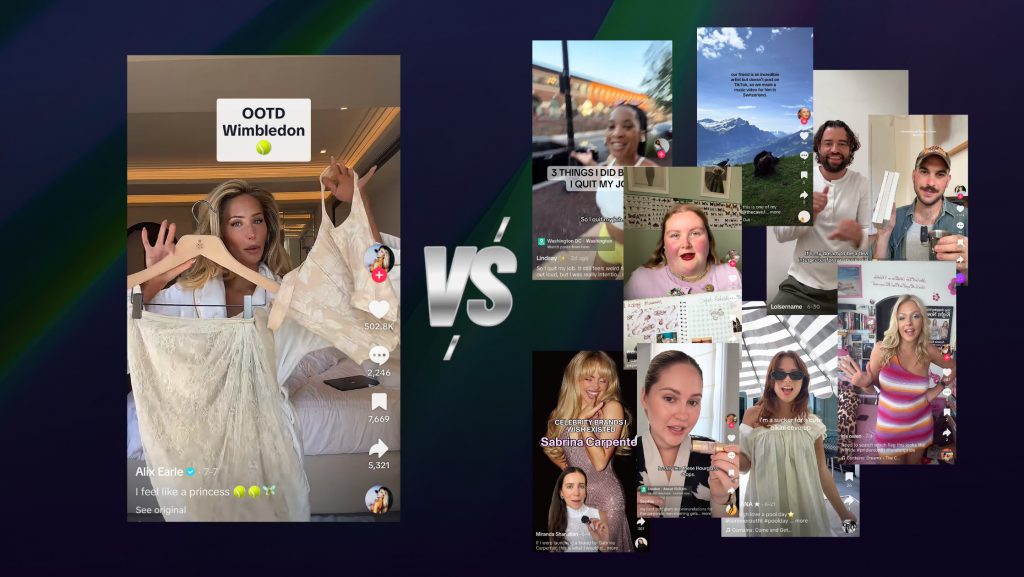
Every few months, a brand asks us some version of the same question, just dressed up differently: “should we book loads of nano creators, or do we just go big?”
Pick a side, any side. Half the room is team spray-and-pray: book a hundred nanos, let the algorithm sort out the winners and put paid social behind the ones that perform. The other half is team go-big-or-go-home: skip the noise, just get a couple of Megas. Both leave the meeting feeling very sure of themselves.
New Hypetap Intelligence data proves neither should; both sides are wrong.
Where creator performance actually lives
We looked at sponsored content engagement across thousands of creators, tested across the US, Europe and Australia. Same measure, same method everywhere: how sponsored posts perform against non-sponsored ones, tier by tier, from Nano through to Mega.
The shape of the results held everywhere we looked.
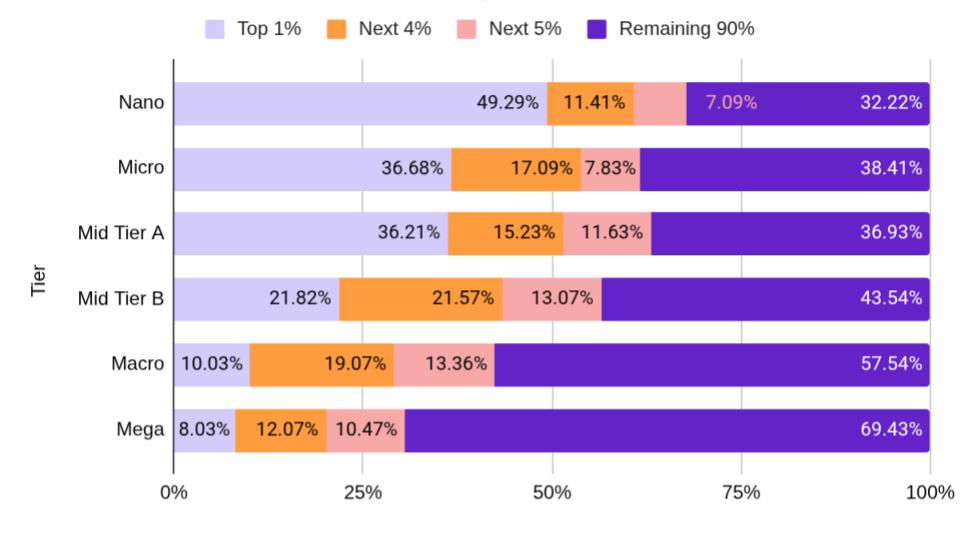
In the Nano tier, the top 1% of creators drive 49.3% of all sponsored content engagement. By Mega, that figure drops to 8.0%.
Now read that twice. In Nano, half the result sits with one in a hundred creators. The other ninety-nine are still creating content, but they are significantly underperforming.
And it’s not a Nano problem specifically. Every tier has a top 1% with a significant concentration of the outcomes, that’s very normal and entirely expected. It’s just far more extreme the smaller you go, and, opposite to costs, it eases steadily as creator size rises.
Why the smaller tiers are so concentrated
Here’s our read on the mechanism, and once you see it, you won’t be able to unsee it (that’s a good thing, promise).
Picture two Nano creators. Similar following, similar niche, similar production value, even. One posts a video that catches: a weird little hook, a genuine laugh, whatever it is. People stick around, so the algorithm shows it to more people. More of those people stick around too. That creator’s month looks nothing like the tier average.

The other posts something perfectly decent that just doesn’t catch. Nothing wrong with it. It simply doesn’t snowball. Their month looks like everyone else’s tier average: quiet and slow.
That’s the pattern right there. Good content earns real engagement. The algorithm rewards that engagement with more reach. More reach compounds into more engagement again. And so quality snowballs into performance.
At Nano and Micro level, that snowball is doing all the work, because there’s no owned audience underneath to catch a creator if a post doesn’t take off. One post lands, and the creator’s numbers look nothing like the tier average. One post doesn’t land, and neither does the campaign line item.
At Macro and Mega, a large, stable following cushions that swing. Reach is owned, rather than chased. Which explains why concentration falls as tier size rises: the compounding effect matters most exactly where creators have no floor beneath them.
That’s the theory that keeps on proving out, in every market we’ve tested so far.

The brief decides whether the snowball even starts
There’s one variable that tips this before a single view is counted, and it’s the one brands have the most direct control over: how prescriptive the brief is.
You’ve seen the brief in question. Five mandatory brand phrases. A shot list that reads like a shot list. The hashtag, spelled correctly, used exactly three times. It’s not a brief anymore, it’s a script with a creator’s face attached.
Overly controlled briefs like that push content away from a creator’s own style, and that style is precisely what their audience trusts them for. Audiences have become hyperaware of being sold to, and they don’t bite the moment something feels scripted. The early engagement that kicks off the whole compounding effect never really gets going. No engagement, no reach, no snowball, regardless of how good the underlying creator is.
We see this play out in delivery constantly.
It’s also a conclusion System1 reaches entirely independently in their own creator effectiveness research: overdirection kills the emotion an ad needs to work at all, regardless of who’s fronting it. Two separate bodies of research, working from different data sets, landing on the same point. Surely, it can’t be ignored any longer.
The practical read for brands: the tightest brief isn’t the safest bet. It’s very often the opposite: the tighter the brief the more it’s capping your own result.
Two seductive answers, both wrong
Because this isn’t news to us anymore, we already know what you’re thinking. Once brands see data like this, they tend to reach for one of two fixes. Sound familiar, team spray-and-pray and team go-big-or-go-home?
Fix one: spread the budget across more small creators. Book 100 Nanos instead of 20, and surely the risk spreads with it. Well, let us tell you, it doesn’t. You’re not de-risking anything, you’re buying more tickets in the same lottery. The top 1 to 5% still carry the result. The other 95% still don’t move it, however many of them you add.
Fix two: just go big. Skip the lottery altogether, put the budget into Macro and Mega, where performance is consistent. Bigger names, bigger price tags, a campaign report that looks lovely and reassuring. This is true, but it’s worth asking why it’s consistent. Often it’s because the audience is broader and the content plays it safer, so everyone converts at closer to the same, lower rate. It’s dependable, sure, but it isn’t necessarily effective, and it costs a great deal more to find out.
Neither extreme is the fix. Nano, Micro, Mid and Macro all have a job to do in a media mix. The question was never how many creators, or how big. It’s landing on the right mix, sized to what your product and audience need.
Where this leaves brands
Creator marketing has been treated as unpredictable for ages now, not because it is unpredictable by nature, but because most brands have never been able to see where the performance truly sits, tier by tier, before they spend against it.
Alternatively, brands run with whatever mix of tiers their budget happens to land them in, rather than the other way around. Budget matters, of course it does, but different audiences need different mixes of tiers, and that’s something you can diagnose early, before a penny is spent, thanks to the 10 billion+ data points sitting inside Hypetap Intelligence.
That’s the gap Hypetap is built to close. Using our data platform, we’re not picking a single winning creator on a hunch or based on a different campaign from a different client just because it worked: we’re building the tier mix that puts this concentration pattern to work for a brand instead of against it. Add a brief that gives creators room to do what got them noticed in the first place, and you’ve got both halves of the fix.
So, whichever team you walked in as. Happy to have you leave as team right-mix.
Consider this our opening move. There are countless more layers within these creator tiers for us to peel back, and we intend to publish every insight as it surfaces.